Working prototype · Baku ID 2026 · Offline-first Edge AI
SeetheWorld.HearWhatMatters.
AI-powered smart glasses that help blind people navigate safely, understand surroundings, read text, recognize familiar faces, and make independent decisions in real time.
The Problem
Sight loss shouldn't mean losing independence
White canes feel one metre ahead. Guide dogs cost $50,000+. Premium devices like OrCam cost $4,500 and still don't warn about an open manhole.
285M
people worldwide live with visual impairment — 39M fully blind (WHO).
Every day
Open manholes, stairs and traffic are daily life-threatening hazards in cities.
The gap
Existing aids describe objects — they don't make navigation decisions.
Mosttechnologydescribestheworld.Ablindpersoncrossingastreetneedsmorethandescription—theyneedadecision.VVAwatches,remembers,weighsthedanger,andsaystheonesentencethatmatters.Calmly.Intime.Evenwithnointernetatall.
The Solution
A co-pilot for the streets, not a narrator
VisionVoiceAssist fuses computer vision, a cognitive decision layer and natural Azerbaijani speech into one wearable.
Sees & prioritises
80+ object classes with stable tracking. In a 20-object scene it speaks max 2 calm sentences — danger first, always.
Life-saving hazard layer
Stairs, holes, open manholes (circular-signature detection), crosswalks, curbs — fully on-device, 3-frame confirmation, zero-false-alarm tested.
Decides, not describes
“Obstacle ahead — pass on your left.” Clock directions, step distances, wait/stop commands. A fail-safe engine blocks risky advice.
Reads the world
Signs, menus, price tags in AZ/EN/RU/TR. Stops-and-reads automatically; prices spoken in words.
Recognises loved ones
“Your mother is in front of you.” Encrypted on-device face database — biometrics never leave the glasses.
Interrupts for danger
A critical warning cuts any speech in under 300 ms — measured by automated tests, with pre-cached emergency audio.
The Hardware
Inspect the prototype. Every angle.
Drag to rotate · scroll to zoom · tap the glowing points to open each module. This is the actual product geometry — not an illustration.
Built on Raspberry Pi 5
Quad-core edge compute inside the temple — no phone, no tether.
Edge AI
Detection, hazards, OCR, faces and speech run fully on-device.
Offline Safety
Zero cloud dependency for anything that keeps the user safe.
Live AI — not a mockup
Talk to the brain. Feed it your world.
This is the same Gemini vision brain the prototype runs when online. Upload a photo and hear exactly what the glasses would say — or just have a conversation with VVA.
objects, hazards, text, and the exact sentence they would speak.
Photos are resized in your browser, analysed once, never stored. Free-tier AI — if it rate-limits, give it a minute.
Real-World Scenarios
Press play on a day in the life
Each scenario replays the exact module chain the glasses execute — same order, same rules, same words.
Interactive Architecture
Click any stage. See why it exists.
Nine isolated, tested modules on one event bus — from photons to a calm Azerbaijani sentence.
Camera
USB/CSI capture with automatic reopen — 3 consecutive timeouts trigger announcement + recovery loop, never a crash. File/RTSP sources supported for testing.
System Telemetry
An operating system for the street
Replay of desktop-session telemetry (values animated for display — measured baselines: 13.4 FPS camera, 10.7 ms CV layer, 88 MB RAM, <300 ms danger interrupt).
Camera FPS
13.4
CV layer / frame
10.7ms
AI confidence
91%
Objects tracked
6
Hazards
0
Speech queue
1
RAM
88MB
Danger latency
240ms
Offline-First
Works anywhere on Earth. No internet required.
The entire safety layer — detection, hazards, traffic lights, OCR, face recognition, speech — runs on-device. Cloud AI (Gemini → Claude fallback chain) only adds richer scene descriptions when available. Lose connection mid-street? The glasses announce it and keep protecting you.
- Models pre-downloaded at install time
- Automatic online/offline switching in <2s
- Local TTS chain: Piper → pyttsx3 → espeak → beep
- Encrypted local face & place memory
100%
safety features offline
<2s
offline failover
4
OCR languages
0
cloud dependency for danger
Technology
Battle-tested stack, edge-optimised
automated tests — all passing
max danger-interrupt latency
object classes recognised
critical CVEs (pip-audit)
Privacy & Safety
Trust is the core feature
Faces stay on-device
Biometric embeddings are Fernet-encrypted locally. Frames sent to cloud are face- and plate-blurred first — provable via the live dashboard.
Threat-modelled
10 attack vectors documented with mitigations and test evidence. Secrets masked in logs. Dashboard is localhost + token only.
Fail-safe by design
After any hazard, movement advice is blocked for 6 seconds — the system says “stop”, never a risky direction. Uncertain? It stays silent.
Market Opportunity
A $7B assistive-tech market with no affordable leader
285M visually impaired people globally · ~70,000 in Azerbaijan alone · B2C device sales + B2G social-support programs. The i18n-centric core makes Turkish, Russian and Georgian markets a module away.
| VisionVoiceAssist | OrCam MyEye | White Cane | |
| Price | ~$200 BOM | $4,500 | $40 |
| Hazard warnings (manhole, stairs) | ✓ on-device | ✗ | 1m reach only |
| Navigation decisions | ✓ “pass left / stop” | ✗ describes only | ✗ |
| Works offline | ✓ 100% of safety | partial | ✓ |
| Azerbaijani (native-quality) | ✓ first-class | ✗ | — |
| Face recognition (encrypted, local) | ✓ | ✓ (cloud-linked) | ✗ |
| Learns from user feedback | ✓ | ✗ | — |
Engineering Quality
Due diligence welcome. The code holds up.
Not a hackathon script — a release candidate with CI-grade evidence behind every claim on this page.
automated tests, all passing
line coverage
lint findings (ruff, 414 fixed)
known CVEs (pip-audit)
Documented
Architecture map, developer guide, threat model, security setup, release notes with honest limitations, phase reports.
Hardened
Threat-modelled (10 vectors + mitigations), secrets masked in logs, encrypted biometrics, localhost+token dashboard.
Operable
systemd watchdog, OTA updates with rollback, endurance & FPS benchmark tooling, doctor command for field diagnostics.
Meet the Founder
Built end-to-end by one determined founder
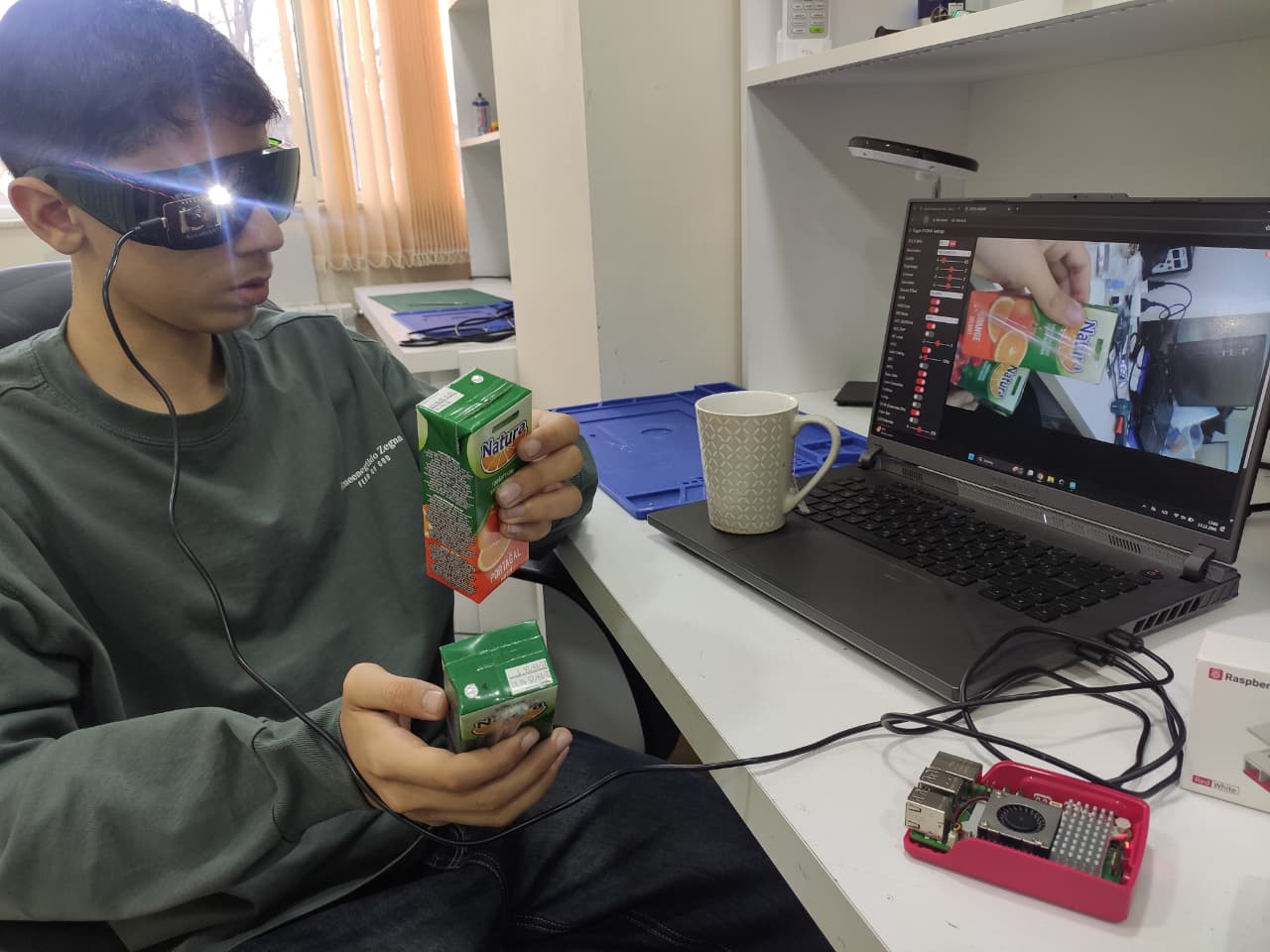 PROTOTYPE · LIVE TEST
Aliasgar Fatullayev
Founder & Engineer · 14 y.o. · Baku, Azerbaijan
Designed and shipped the entire system — vision pipeline, cognitive layer, speech chain, hardware integration, security model and this website — through 10 engineering phases with test evidence at every gate.
LinkedInStarted programming self-taught in Baku
First Raspberry Pi experiments
Computer vision & edge AI deep-dive
VVA architecture: offline-first, fail-safe by design
Working prototype — 556 automated tests
Desktop edition running live
Baku ID 2026 — stage demo
Mission: independence for every blind person
Roadmap
From prototype to platform
Working prototypenow
556 passing tests · desktop edition live · v1.0 release candidate tagged
Baku ID 2026now
Live stage demo: hazards, traffic light, OCR, face recognition, offline failover
Pilot with blind community
20-user field trial in Baku with the Society of the Blind; feedback-learning loop
Hardware rev. 2
Custom frame, ToF distance sensor, bone-conduction audio, 8h battery
Regional expansion
Turkish & Russian language packs — the core is already i18n-first
For Investors
Real device. Real code. Real users waiting.
Seeking seed funding for hardware rev. 2, the 20-user Baku pilot and certification. Full technical due-diligence pack available: architecture, threat model, test reports.
Working prototype
Runs today on Raspberry Pi 5 and any Windows laptop — same core.
Offline edge AI
No cloud bills per user. No connectivity risk on stage or street.
Pilot-ready
Systemd watchdog, OTA updates with rollback, 60-min endurance tooling.
Founder velocity
Built by a 14-year-old founder from Baku — 10 engineering phases shipped with test evidence.
Future Pilot Partners
Who we're building the pilot with
Conversations planned for the 20-user Baku field trial. Shown as categories — no signed partnerships are claimed yet.
Society of the Blind
IN DISCUSSION · PLACEHOLDER
Special Schools
IN DISCUSSION · PLACEHOLDER
Hospitals & Clinics
IN DISCUSSION · PLACEHOLDER
Universities
IN DISCUSSION · PLACEHOLDER
NGOs & Foundations
IN DISCUSSION · PLACEHOLDER
City Accessibility Programs
IN DISCUSSION · PLACEHOLDER
Pitch Deck
The full story, investor-ready
- Problem → solution → live prototype evidence
- Architecture, threat model & test reports included
- Market sizing: 285M worldwide · ~70k in Azerbaijan
- Roadmap to 20-user pilot and hardware rev. 2
FAQ
Judges ask. We answer.
Why Raspberry Pi 5 instead of a phone?
A phone occupies the hand a blind user needs for their cane. Pi 5 integrates into the glasses, drives a haptic motor over GPIO, and runs the full vision stack locally for a ~$200 bill of materials — 20× cheaper than OrCam.
What happens when internet drops?
Nothing critical. Detection, hazards, traffic lights, OCR and speech are all on-device. The glasses announce “switched to offline mode” within 2 seconds and keep going; cloud descriptions resume automatically.
How do you prevent false alarms?
Floor hazards need 3 consecutive confirming frames; identical alerts are rate-limited; a 100-frame noisy-corridor test must produce zero alarms in CI. Below 35% confidence the system deliberately stays silent.
Is the face data safe?
Only 512-dimension mathematical embeddings are stored — never photos — encrypted with Fernet on the device. Frames leaving for cloud description are blurred first. One command deletes a person forever.
Is this a demo or a product?
It's a release candidate: 556 automated tests, zero lint findings, zero known CVEs, systemd watchdog, OTA with rollback. Experimental parts (behaviour prediction, voice queries) are explicitly labelled as such.
Contact
Let's give sight a voice — together
Demo requests & investor conversations welcome. Based in Baku, Azerbaijan.